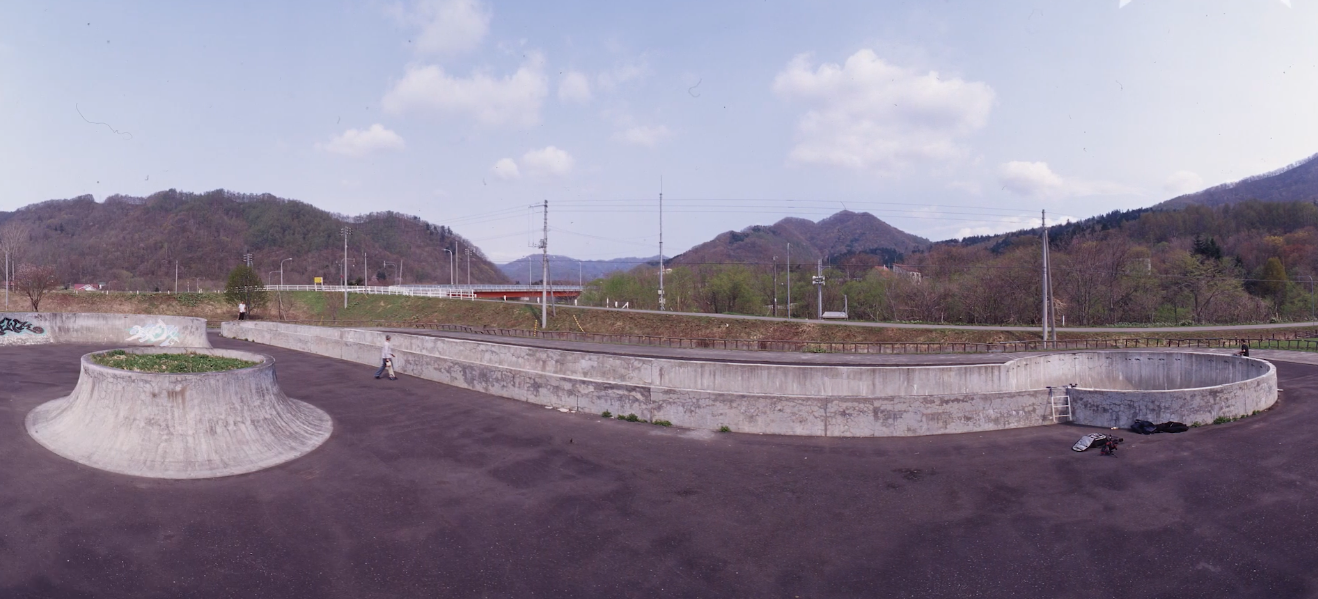
| Japanese | みかさ遊園 ローラースケート場(デスボール) |
| Prefecture | Hokkaido (北海道) |
| City | Mikasa |
| Address | N/A |
| Type | Outdoor |
| Surface | Raw, weathered cast concrete (rough — soft wheels recommended; closed to the public since 2003) |
| Hours | Closed to the public since 2003 |
| Closed | Permanently closed |
| Admission | N/A |
| Website | Official site |
The Mikasa Yuen Roller Skate Course — known internationally among skateboarders and BMX riders as "The Death Bowl," "The Lost Park," or the "Jurassic Skatepark" — is a defunct concrete roller-skate course tucked inside Family Land Mikasa Yuen, a small family amusement park in the mountains of Mikasa, Hokkaido. Built in 1980 by Japan's national Employment Promotion Agency (雇用促進事業団) as a public roller skating facility, the course features a steep concrete halfpipe and an S-shaped concrete transition tray, both cast directly into the hillside. The City of Mikasa closed it to the public in 2003 due to deteriorating concrete that small repairs could no longer keep safe, and it has remained fenced off and signed as off-limits ever since — now bordered by the family park's water-play pond and campground. Despite being closed for over twenty years, the course has gained a near-mythical status in international skate media for the rarity of its shapes, the rawness of its surfaces, and the surreal experience of riding a half-forgotten Showa-era public works project in the middle of a Hokkaido picnic ground.
History
The course was constructed in 1980 (昭和55年) as part of a national initiative by the Employment Promotion Agency (雇用促進事業団), a special public corporation that funded local recreation infrastructure across post-war Japan. It opened to the public as a roller skate facility — at the time considered a fashionable youth pastime — and operated for roughly two decades alongside the rest of Family Land Mikasa Yuen.
By the late 1990s the concrete had begun to deteriorate, and the city kept the course running through small ad-hoc repairs. In 2003 (平成15年) those repairs could no longer guarantee safety, and the City of Mikasa suspended public use indefinitely. It has been fenced off and posted as off-limits ever since.
In the years that followed, the course was rediscovered by Japanese and international skateboarders and BMX riders, who found that its shapes — designed for 1970s-era roller skating — translated unexpectedly well to modern transition skating.
In September 2024, the Mikasa City Council formally discussed the future of the facility (令和6年第3回三笠市議会定例会). Councilman Yasuhiro Aoki described the course as "world-famous — when skateboarders say *Mikasa*, this is what they mean," and asked whether the city would consider repairing and reopening it. The Industry Policy Promotion Department responded that public reopening was not feasible — citing repair costs, the absence of qualified instructors, low historical attendance, liability proximity to the family park's children's facilities, and the fact that current Japanese building code (建築基準法) would not permit construction of a similar structure today. The city did, however, indicate willingness to transfer operations to a private entity capable of running it independently. As of the most recent public records, no such operator has formally taken it over.
Facilities
- Concrete halfpipe (steep
- Showa-era roller-skate spec)
- S-shaped concrete transition tray
- Cast directly into hillside
- No lights
- No restrooms inside the rink area
- No on-site skate staff
- Fenced and signed as off-limits since 2003
Access and Fees
| Address | N/A |
| Opening hours | Closed to the public since 2003 |
| Closed days | Permanently closed |
| Admission | N/A |
| Website | https://www.city.mikasa.hokkaido.jp/sightseeing/detail/00005735.html |